Ayin Tachas Ayin
There's a certain kind of question that motivates me. It's when you come across a phrase in the Torah — a law or idea — that seems cruel. Primitive. Obviously so. G-d's command to totally wipe out Amalek — men, women, and children — obviously comes to mind, but as we shall soon see, there are other examples also.
For many people, the reaction and analysis stop there. They simply take the surface impression and walk away.
I can't do that.
This is the same Torah that tells us that man is created in the image of G-d. The same Torah that says: do not murder, do not steal, do not lie in court. The Torah that commands us to love our neighbors as ourselves. To care for the stranger — because we know what it's like to be a stranger, because we were strangers in Mitzrayim. To do what is good and what is straight in the eyes of Hashem. To have honest weights and measures. To take care of the poor. To be holy. And more (much more).
Time and again, the Torah is filled with moral depth and sophistication — and not merely filled with it, but revolutionarily so. It is unmatched in history. Thousands of years later, the moral clarity of the Torah rings out as brilliantly and as brightly as it always has — this is true on the level of peshat, and even more so when one takes the time to study the Torah in-depth.
As such, if we come upon what looks like an exception to that rule — something that seems immoral, uncaring, primitive, cruel — and we simply stop there, then the problem is not what's written in the Torah.
The problem is how we approached the Torah. The problem is that we didn't take the time to see how this too is moral. This too is just. This too is deep and sophisticated.
If we don't search, we shouldn't be surprised if we don't find.
And there's another issue.
We can't simply treat the Torah like any other work — like the work of a great scholar, a great author, a great mind. We are talking about the Author of all authors, the Mind of all minds. The Creator Himself, revealing to us His will and how we are to live our lives.
To dismiss these words as primitive is to claim that the Creator of morality Himself somehow failed to understand basic moral principles.
I tell you all of this because it is the fuel which powers this week's dvar Torah — and it relates to one of the most famous lines in the Torah:
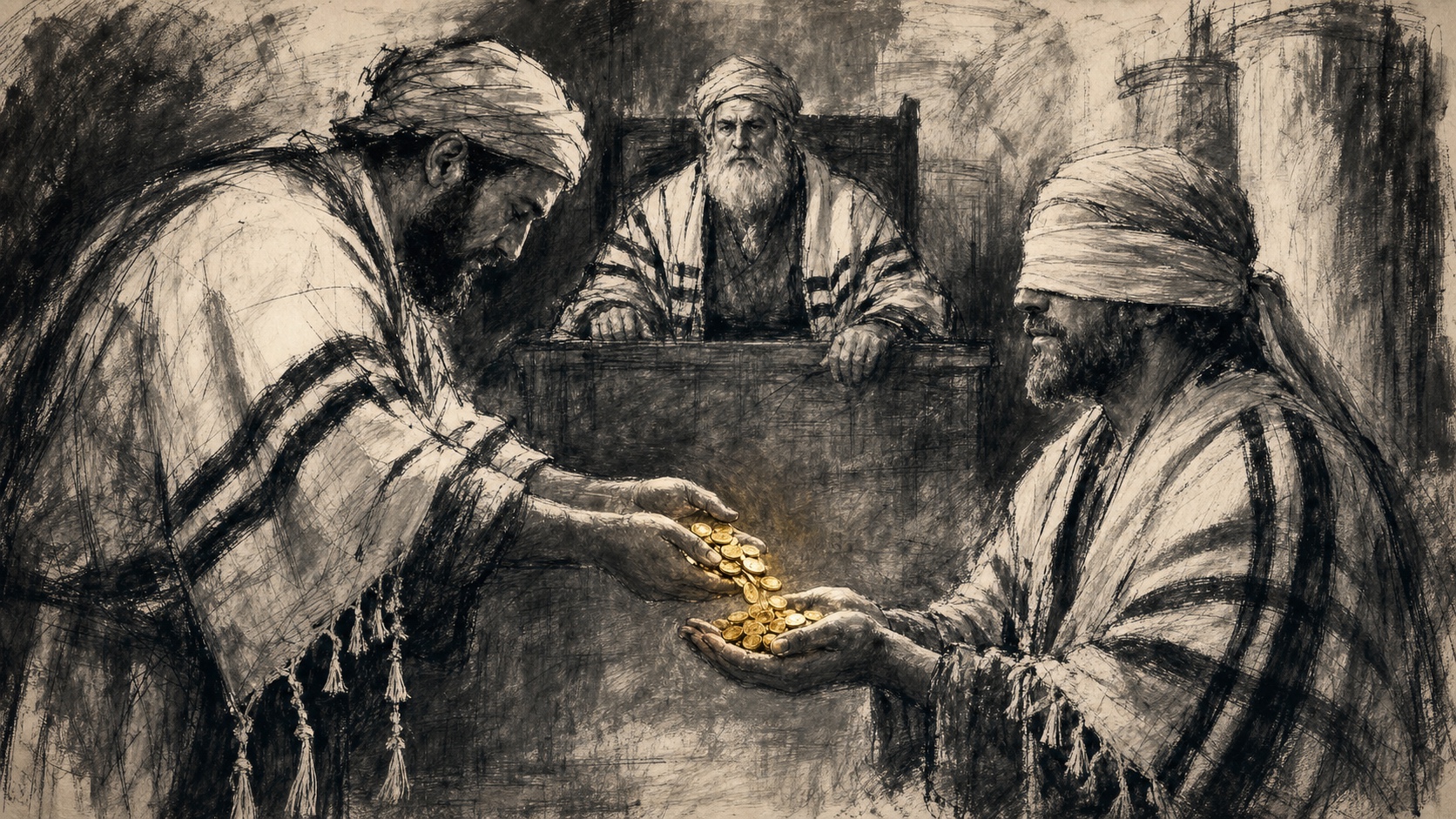
"An eye for an eye" — עין תחת עין.
Time after time, from person after person and institution after institution, this line is presented as the basis for a cruel, primitive form of justice. We'll start with Matthew — yes, that Matthew — who understood "an eye for an eye" as a base form of retaliation: doing unto an evildoer the very evil he has done to you.
From there we move on to the early Church Fathers — and those who followed in their wake — who understood this as a law of permitted retaliation: revenge is allowed, but limited to the extent of the damage that the victim suffered. A legalized form of revenge, a moral version of revenge — but revenge nonetheless.
So said the Church Fathers. So says the modern-day Catholic Church.
Tolstoy stated that the law of an eye for an eye was a law of violence. Mahatma Gandhi famously proclaimed that "an eye for an eye leaves the whole world blind."
Now, may I pause for a moment to note that for all of its poetic beauty, Gandhi's line doesn't make any sense.
Even if we take the verse literally (as he does), his conclusion only follows if we live in a world in which people are continuously blinding one another. But if I do not take out your eye, and you do not take out mine, then neither of us will be blind.
Indeed — are we all dead because we execute murderers?
I certainly hope not; it would greatly reduce my readership ;-)
But I digress.
I will leave with one more quote — this one said all but yesterday by Pope Francis:
"If we live according to the law 'an eye for an eye, a tooth for a tooth,' we will never escape the spiral of evil."
Here this law has been elevated to the status of a worldview and modus operandi, one that condemns us to a never-ending spiral of evil. Sounds like it doesn't get much worse than that!
Over and over again, this line is taken literally — as prescribed revenge, as an immoral worldview. Over and over again, it is misconstrued and misunderstood.
And when I hear that, I feel like a young David standing before the mighty Goliath, listening as the giant confidently blasphemes the G-d of Israel.
So, like David, I pick up my weapon of choice — the very words of the Torah themselves — and prepare to forge a new path for all those who care about the truth of what this short little phrase actually means.