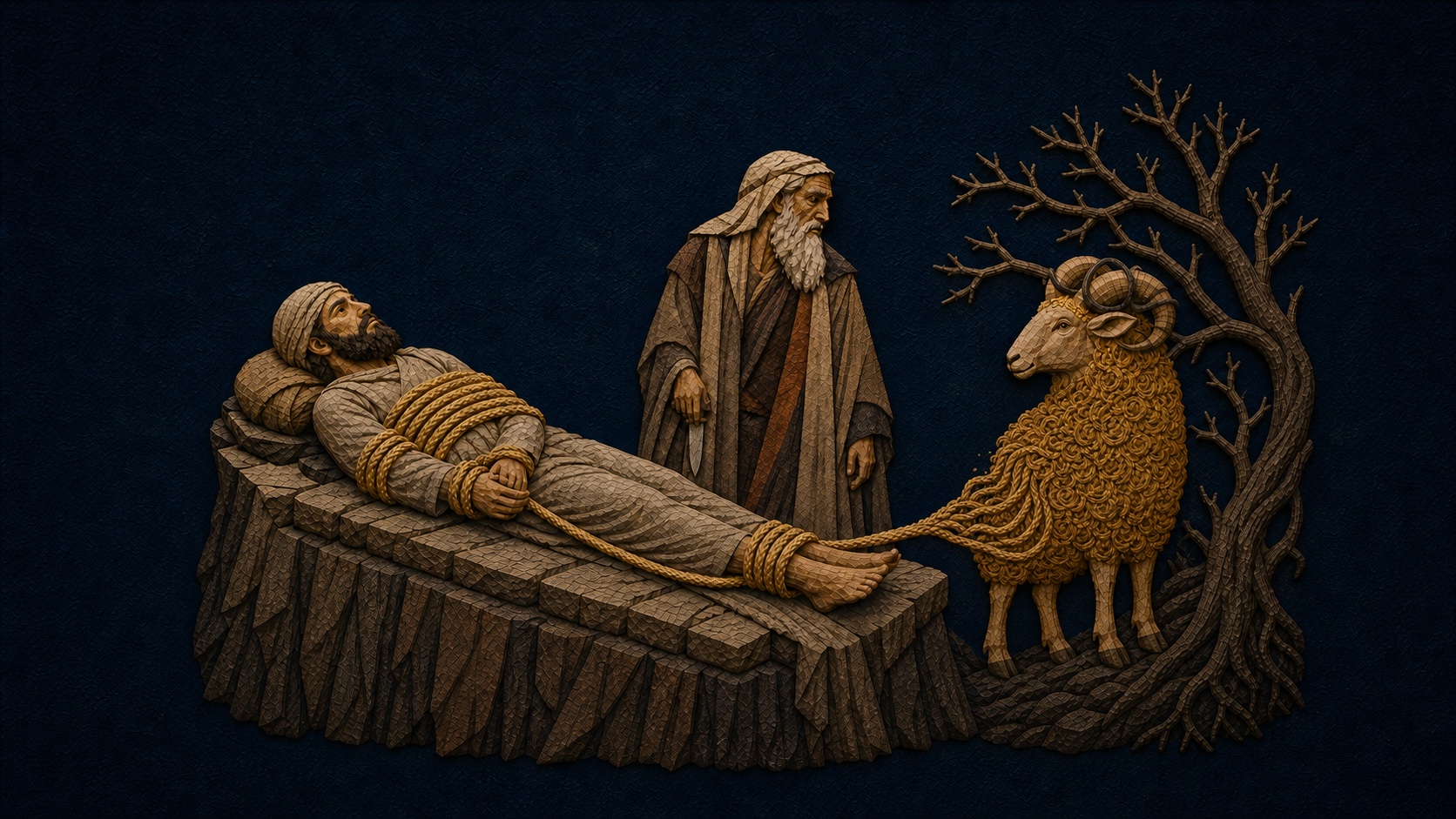
The Deeper Meaning of the Akeida
For many of us, the idea that Avraham would be willing to sacrifice Yitzchak without voicing a single objection seems beyond comprehension. Avraham, after all, is the man who challenged G-d Himself when He planned to destroy Sodom — a city steeped in wickedness.
Avraham understood the people of Sodom. He knew their corruption. But he objected to the idea that the righteous would be punished alongside the guilty. "Ha-shofet kol ha'aretz lo ya'aseh mishpat?" — Will the Judge of all the earth not act justly?
And so, when that very same G-d commands Avraham to sacrifice His son, we wonder - is not Yitzchak also righteous? And didn't G-d Himself promise that through Yitzhack the Jewish people would be born?
And yet, no questions. No pleas. No signs of doubt. Avraham simply gets up and goes. He is willing to sacrifice his son without voicing any concern whatsoever.
How can that be?
Clearly there is some distinction - something that differentiates the Akedia from Sodom and Amora. One such distinction that I heard is the difference between being informed and being commanded.
By Sodom and Amora G-d informed Avraham of what He plans to do. By the Akeida, G-d commanded Avraham what to do.
I would like to offer an additional distinction, one that gets to the very heart and purpose of the Akedia itself - and that is the distinction between justice and sacrifice.
The story of the Akeida is not a story of G-d enacting justice in the world. Neither Avraham, Yitzchak or anyone else is guilty of a crime that warrants a punishment.
That is not the case by Sodom and Amora. There G-d was responding to their wickedness and declaring that it warranted a response. And Avraham was inquiring of G-d how exactly Divine justice operates in this world. Will G-d be unjust in His application of justice?
Heaven forbid, Avraham said. And, indeed, heaven did forbid.
But here, by the Akeida, we are entering into an entirely different realm of reality - namely, the world of sacrifice. Sacrifice is not about what is fair or just; rather it is about love, devotion, and offering back to the Creator what is already His.
When G-d, informed Avraham that He was about to punish the people of Sodom and Amora, Avraham responded because He was attempting to understand how exactly G-d's justice works in His world.
But when G-d commanded Avraham to sacrifice Yitzchak, G-d was directing Avraham to make a sacrifice. To take all that he held dear in this world - his hopes, dreams, purpose, love and connection - and to offer all of that to G-d.
And to this, Avraham said yes.
It is, of course, a difficult yes. Does G-d want us to serve Him by sacrificing the righteous? For many of us, this sounds anathema - but, of course, we live in a post-Akeida world. One where the lessons of the Akeida have been internalized.
But if we really want to understand the Akeida, we need to go to the moments before the Akeida and understand this type of sacrifice, why G-d would command it and why Avraham would be so ready and willing to agree.
And while we are there, we will need to address a related question: if G-d never intended Avraham to kill Yitzchak, why did He ask Avraham in the first place.
In other words, if there is value in this level of sacrifice - then let Avraham actually sacrifice Yitzchak. But if G-d Himself objects to us serving Him this way, then why ask Avraham to do something that G-d does not actually want him to do?